Strategic judgment
Chooses where the company can win, and explains the trade-offs behind those choices. A growth target is translated into customer, product, channel, and capacity assumptions.

THE EXECUTIVE REVENUE GUIDE
The mandate, the responsibilities, and the decisions behind executive revenue leadership. A practical guide for founders, boards, and future CROs.
01 / THE CRO GUIDE
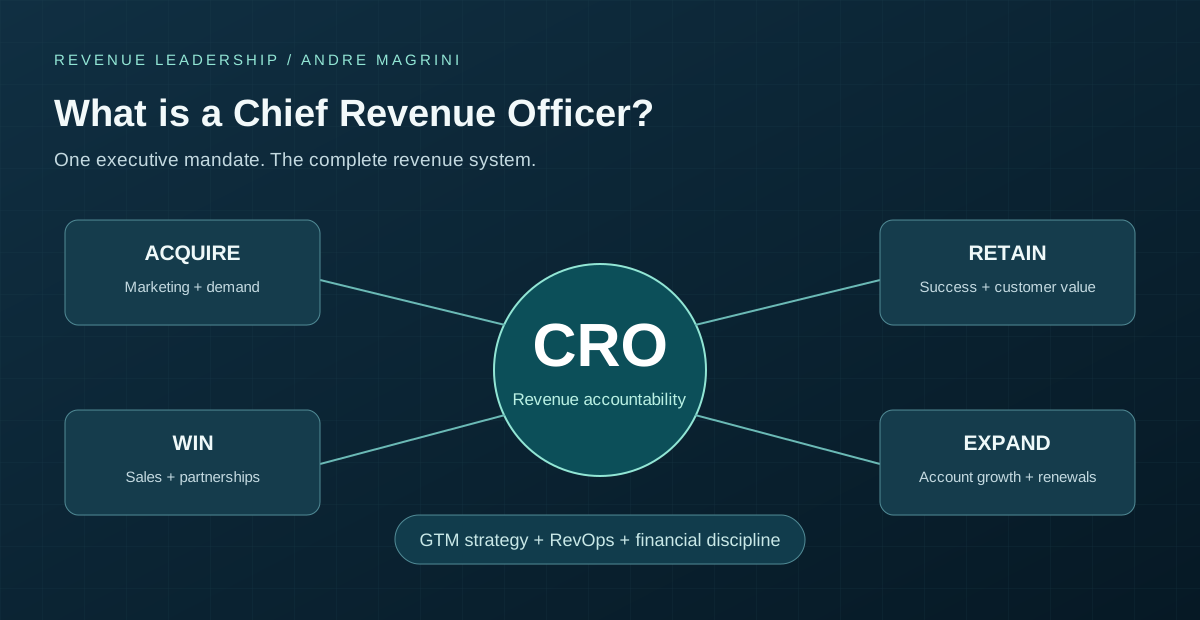
A Chief Revenue Officer is the executive accountable for the strategy and coordination of a company’s revenue system, from acquiring customers to retaining and expanding their business. The CRO connects go-to-market strategy, sales, marketing, customer success, partnerships, and revenue operations around shared commercial goals.
The job is to make the relationships between those functions work. A marketing campaign that attracts the wrong buyers, a sales team that promises an undeliverable outcome, and an onboarding process that loses customers can all damage the same revenue plan. A CRO makes those dependencies visible and assigns decisions to named owners.
In B2B SaaS, the mandate often includes recurring revenue, renewals, churn, and expansion. In services, manufacturing, or distribution, it may emphasize project economics, repeat purchases, dealer performance, channel inventory, margin, and cash collection. The title stays the same; the operating model changes.
02 / THE CRO GUIDE
A CRO translates the company’s growth ambition into market choices, revenue targets, investment priorities, and a repeatable operating cadence. The scope should be explicit in the executive mandate; the title alone does not establish authority over every commercial function.
| Responsibility | What the CRO decides or coordinates | Practical output |
|---|---|---|
| Revenue strategy | Which customers, problems, markets, and routes to market deserve investment. | A revenue plan with segment priorities, assumptions, and accountable owners. |
| Go-to-market alignment | How positioning, demand generation, selling, onboarding, and expansion connect. | A shared customer journey, qualification standard, and handoff contract. |
| Sales leadership | How capacity, territories, incentives, sales process, and deal inspection support the plan. | A capacity model and an evidence-based pipeline review. |
| Retention and expansion | How the business delivers value, manages renewal risk, and earns further customer investment. | A customer health review and expansion plan. |
| Pricing and monetization | How packaging, discount authority, value communication, and commercial terms work with Finance and Product. | Pricing guardrails and a decision log. |
| Forecasting and RevOps | Which data, definitions, systems, and evidence support revenue commitments. | A common forecast, metric dictionary, and CRM governance. |
| People and executive communication | Which capabilities the team needs and which trade-offs need CEO or board decisions. | A hiring plan, coaching cadence, and concise executive report. |
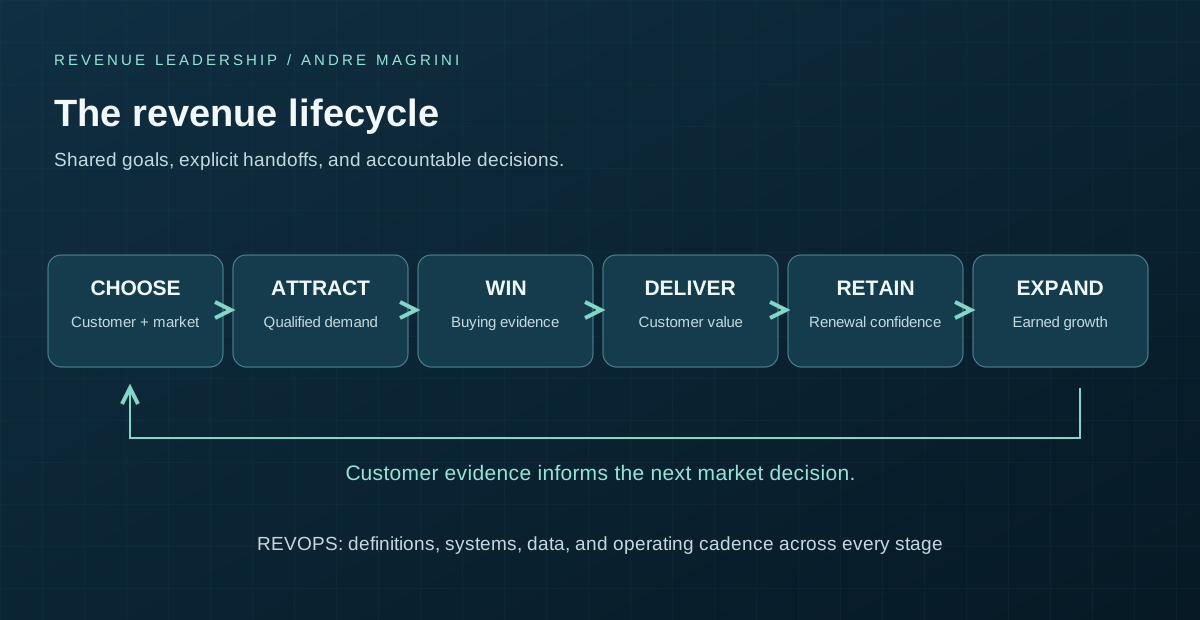
A useful week combines pipeline inspection, customer and partner conversations, forecast review, coaching, and cross-functional decisions. The CRO examines changes in qualified pipeline, stalled opportunities, customer adoption, renewal exposure, and capacity. The goal is to leave each meeting with a decision, an owner, and a date, rather than a larger reporting burden.
03 / THE CRO GUIDE
The CRO role reflects a shift from managing separate commercial departments to coordinating the economics of the complete customer relationship. Subscription businesses made that dependence especially visible: a new contract creates little durable value if the customer never adopts the product or cancels at renewal.
This is an operating-model explanation, not a claim that every company followed one historical sequence. Some businesses still place marketing or customer success outside the CRO’s reporting line and rely on shared governance instead.
| Leadership lens | Primary question | Additional responsibility |
|---|---|---|
| Sales execution | How do we win this quarter’s opportunities? | Pipeline, closing, coaching, and quota execution. |
| Customer lifecycle | How do we acquire and keep customers that receive value? | Onboarding, renewals, expansion, and customer economics. |
| Revenue operations | How do teams make decisions using compatible definitions? | Data ownership, handoffs, forecasting, and process design. |
| AI-enabled revenue leadership | Which decisions can automation improve, and who remains accountable? | Evaluation, permissions, human controls, and business outcome monitoring. |
The modern CRO needs commercial judgment and operating discipline. Buying a revenue intelligence platform does not resolve an unclear ideal customer profile, weak product fit, or incentives that reward one team for creating work another team cannot deliver.
04 / THE CRO GUIDE
The clearest distinction is the decision each role owns. Reporting structures vary, so the following comparison describes typical boundaries to clarify in a role charter.
| Role | Primary mandate | Relationship to the CRO |
|---|---|---|
| Chief Executive Officer (CEO) | Company strategy, overall performance, capital allocation, and executive leadership. | Usually the CRO’s manager; approves major organizational and investment trade-offs. |
| Chief Financial Officer (CFO) | Financial planning, reporting, controls, cash, and financial risk. | Partners on revenue planning, economics, pricing controls, and forecast reconciliation. Finance retains accounting authority. |
| Chief Marketing Officer (CMO) | Brand, market understanding, positioning, and demand creation. | May be a peer or direct report; agrees on target customers, pipeline definitions, and lifecycle goals. |
| Chief Sales Officer (CSO) / VP of Sales | Sales organization, selling capacity, territories, pipeline execution, and quota. | Often leads the sales function within the broader revenue mandate. Titles alone do not settle scope. |
| Chief Commercial Officer (CCO) | Commercial strategy, often including sales, partnerships, business development, or marketing. | Can overlap substantially with CRO; compare decision rights and deliverables rather than labels. |
| Revenue Operations (RevOps) leader | The processes, systems, data, and analysis supporting revenue teams. | Builds and maintains the operating infrastructure; the CRO remains accountable for commercial choices. |
05 / THE CRO GUIDE
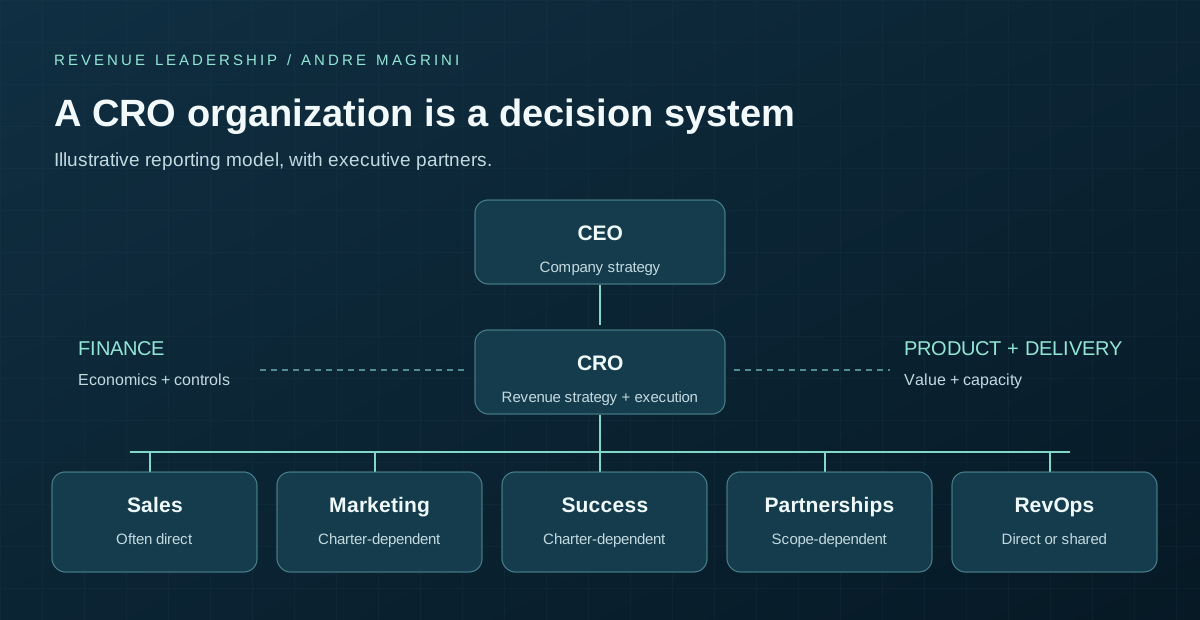
A CRO commonly reports to the CEO and works with the executive team. Direct reports can include Sales, Revenue Operations, Customer Success, Partnerships, and, in some companies, Marketing. Customer Support, Product, Finance, and Professional Services may remain separate while participating in the revenue operating cadence.
| Function | Typical relationship | Boundary to document |
|---|---|---|
| Sales | Often a direct report. | Quota ownership, territories, sales capacity, and discount escalation. |
| Marketing | Direct report or executive peer. | Positioning, demand budget, pipeline acceptance, and brand authority. |
| Customer Success | Direct report or executive peer. | Adoption, renewal ownership, expansion, and escalation. |
| RevOps | Often a direct report or shared function. | Metric definitions, CRM changes, forecast process, and data stewardship. |
| Partnerships / Channel | May be a direct report. | Partner recruitment, sourced revenue, channel conflict, and incentives. |
| Finance and Product | Usually cross-functional partners. | Accounting, margin controls, product commitments, and release priorities. |
One accountable executive does not require every specialist to report into one hierarchy. It requires a shared plan and a way to resolve conflicts when department goals compete.
06 / THE CRO GUIDE
Chooses where the company can win, and explains the trade-offs behind those choices. A growth target is translated into customer, product, channel, and capacity assumptions.
Separates a buyer’s interest from a commitment and a forecast assumption from a fact. Changes a decision when the evidence changes.
Resolves disputes about lead quality, selling promises, delivery, and renewal ownership without allowing customers to disappear between departments.
Understands the buyer’s decision, the user’s workflow, and the economic value delivered. Uses that understanding to improve targeting and retention.
Runs a cadence people can sustain. Reviews decisions and follow-through instead of replacing one dashboard with another.
Reports risk early, resists unsuitable deals, and avoids treating aggressive discounts or unrealistic promises as durable growth.
07 / THE CRO GUIDE
A useful CRO job description defines the business problem, reporting relationship, decision authority, available resources, and expected evidence of progress. The following role charter is an adaptable example, rather than a vacancy or a claim about a specific company.
| Charter element | What to include |
|---|---|
| Purpose | Lead an economically sustainable revenue plan across the customer lifecycle. |
| Reports to | CEO, with an agreed executive and board reporting cadence. |
| Scope | Name the business units, markets, products, functions, and revenue streams included. |
| Core responsibilities | Revenue strategy, GTM alignment, sales leadership, retention, partnerships, forecast governance, talent, and operating cadence. |
| Authority | Specify budget, hiring, discount, pricing, territory, and customer escalation decisions. State which require Finance, CEO, or board approval. |
| Qualifications | Evidence of leading commercial teams and making cross-functional growth decisions in a relevant business model. |
| Success measures | Agreed baseline and definitions for revenue, margin, retention, pipeline quality, forecast reliability, and capital efficiency. |
| Working relationships | Sales, Marketing, Customer Success, RevOps, Finance, Product, Delivery, and executive leadership. |
Expect a coherent diagnosis, an explicit plan, and evidence that the operating system is improving. Evaluate outcomes against the starting conditions and actual sales or renewal cycle. A job description that promises immediate revenue growth while withholding pricing, budget, or team authority creates conflicting accountability.
08 / THE CRO GUIDE
CRO compensation depends on geography, company stage, revenue responsibility, industry, team size, and the mix of salary, incentives, and equity. Compare base salary with base salary and total cash with total cash; an on-target package is not guaranteed realized pay.
United States benchmark, checked October 30, 2026: PayScale reports an average CRO base salary of $181,126, with displayed base salary of $102,000 to $253,000 and total pay of $117,000 to $310,000. Its page cites 134 salary profiles, last updated April 2, 2026. These are one provider’s reported figures, not a universal market rate. View the PayScale source and current methodology.
| Component | What it means | What to clarify |
|---|---|---|
| Base salary | Fixed annual cash compensation. | Country, currency, role scope, and employment basis. |
| Variable cash | Bonus or commission tied to defined conditions. | Target, payout curve, thresholds, caps, clawbacks, and when the result is measured. |
| On-target earnings (OTE) | Base plus target variable cash if target conditions are met. | Whether targets are achievable, funded, and aligned with retention and margin. |
| Equity or long-term incentives | Ownership or a contractual long-term participation mechanism. | Instrument, vesting, dilution, exercise terms, and liquidity conditions. |
| Benefits and executive terms | Benefits and other contractual provisions. | Benefits, termination provisions, travel expectations, and employment terms. |
An early-stage business may offer a different cash and equity mix from an established enterprise. A turnaround may attach incentives to restoring the revenue base; a scaling SaaS company may emphasize recurring revenue and retention. Company-size bands require a comparable source sample. No unsupported startup, mid-market, or enterprise salary ranges are presented here.
For a real hiring budget, include employer costs, benefits, hiring costs, incentive scenarios, and the team and systems needed to make the mandate executable. A fractional engagement is a service scope and fee, so it should not be treated as an employee salary benchmark.
09 / THE CRO GUIDE
CRO skills combine commercial strategy, people leadership, finance, customer understanding, and operational execution. Technology knowledge helps the executive ask better questions and assign controls; it does not require the CRO to be the system administrator or data engineer.
| Skill | Application | Evidence in an interview or assessment |
|---|---|---|
| GTM and segmentation | Match the offer, ideal customer profile (ICP), buyer, and channel. | A specific decision to focus on or stop serving a segment, with the rationale. |
| Sales execution and coaching | Improve qualification, deal progression, capacity, and manager effectiveness. | A reconstructed pipeline review and an explanation of changed behavior. |
| Customer lifecycle management | Connect adoption, retention, renewals, and account growth. | A renewal-risk example involving Sales, Product, and Customer Success. |
| Financial literacy | Interpret revenue quality, gross margin, CAC, cash, and investment trade-offs. | A plan that reconciles commercial ambition with Finance’s assumptions. |
| Forecasting and analytics | Build commitments from stage evidence and inspect forecast error. | A prior forecast miss, its cause, and the resulting process change. |
| Talent and organizational design | Hire, develop, and hold managers accountable. | An account of capability gaps, coaching, incentives, and difficult people decisions. |
| Executive communication | Explain uncertainty, options, and decisions concisely. | A board-style narrative with facts, assumptions, risks, and requested decisions. |
| Technology and AI judgment | Select useful systems and govern automated decisions. | A measured use case, evaluation approach, permission boundary, and fallback. |
10 / THE CRO GUIDE
The CRO dashboard should connect revenue outcomes to the operating decisions that can change them. Review by segment, cohort, product, or channel when averages hide differences. Agree with Finance on definitions, timing, exclusions, and the system of record before comparing results.
| Metric | Working definition or formula | Decision and limitation |
|---|---|---|
| Revenue growth | (Current-period revenue minus prior comparable-period revenue) / prior-period revenue. | Compare like periods and account for acquisitions, currency, and seasonality. |
| ARR / MRR | Annual or monthly normalized recurring revenue under a documented policy. | Track recurring business; exclude nonrecurring items. ARR is not recognized revenue or cash. |
| ACV | Annualized contract value under an agreed contract-value policy. | Compare deal economics; document treatment of one-time services and variable usage. |
| Net revenue retention (NRR) | (Starting recurring revenue + expansion - contraction - churn) / starting recurring revenue. | Use the same existing-customer cohort and period; exclude new customers. |
| Gross revenue retention (GRR) | (Starting recurring revenue - contraction - churn) / starting recurring revenue. | Shows preservation before expansion; use the same cohort and scope. |
| Customer churn | Customers lost during the period / customers at the start of the period. | Separate customer churn from revenue churn and define what counts as a lost customer. |
| Win rate | Won opportunities / (won + lost opportunities) for the defined closed cohort. | Segment by source and customer type; define no-decisions and do not count open deals as losses. |
| Sales cycle | Elapsed time between documented start and close events. | Use consistent events and inspect medians and distributions, not only an average. |
| Pipeline coverage | Qualified open pipeline for a target period / remaining target for that period. | Inspect timing, stage evidence, and conversion history; no universal coverage multiple. |
| CAC and payback | Acquisition cost / new customers; CAC / monthly gross profit per customer. | Align cost and acquisition cohorts, timing, and gross-margin treatment. |
| Customer lifetime value (LTV) | Expected customer gross profit over a stated relationship horizon. | Use cohort evidence where possible; a simple churn-based estimate assumes stable behavior. |
| Forecast error and bias | For positive actuals, absolute error / actual; separately track signed forecast minus actual. | Freeze forecast timing and scope. For zero actuals, report absolute error rather than dividing by zero. |
| Gross margin and cash | (Revenue - cost of revenue) / revenue; inspect receivables and collections separately. | Connect growth to delivery economics. Bookings, recognized revenue, and collected cash differ. |
11 / THE CRO GUIDE
Build evidence that you can lead the whole revenue system, then seek a mandate that matches the business model you understand. Strong results in one department are useful, but becoming a CRO requires explaining how decisions affect the customer lifecycle and the company’s economics.
An MBA can help develop financial and strategic skills, and some employers prefer one. It is not a universal credential for the CRO title. The U.S. Bureau of Labor Statistics describes top executives as typically having substantial experience and often a bachelor’s or master’s degree; individual employers set their requirements. Read the BLS education and experience guidance.
12 / THE CRO GUIDE
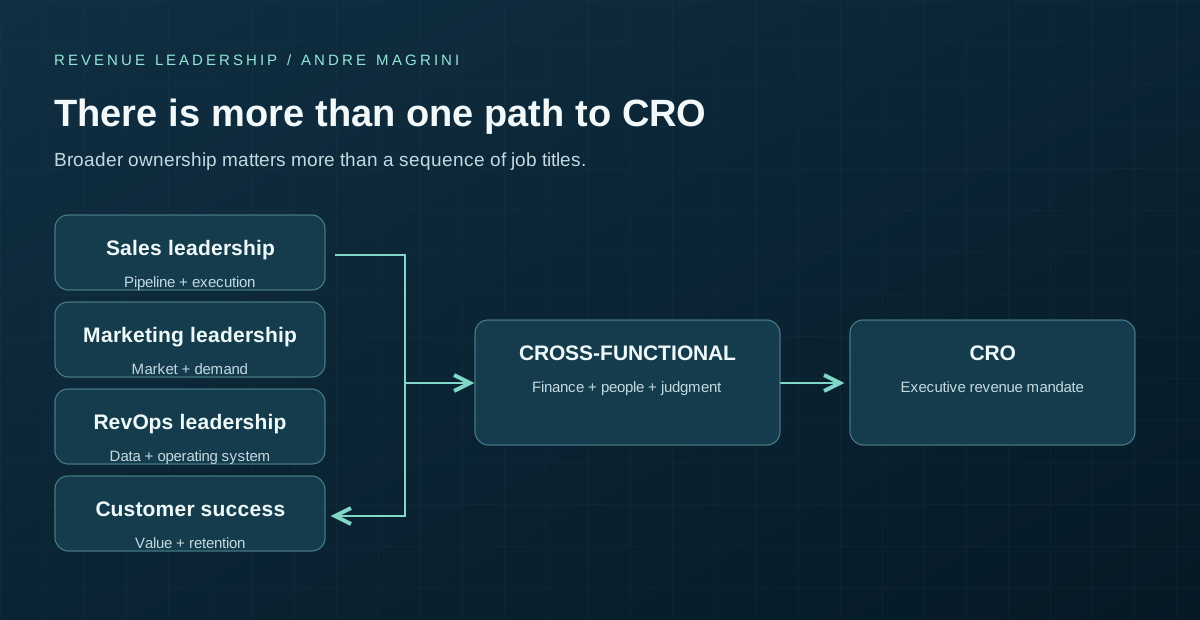
There is no single promotion ladder. Sales leaders need deeper customer economics and marketing understanding; marketing leaders need commercial execution and forecast ownership; operations and customer success leaders need evidence of leading growth and people beyond their original function.
The work is relevant wherever an organization needs coordinated acquisition, retention, and expansion. Availability of CRO jobs depends on industry, investment conditions, company maturity, and the scope assigned to the title. The BLS Top Executives category is broader than CRO, so its employment projections should not be presented as a CRO-specific growth rate. View the BLS occupational scope.
Possible later moves include a larger CRO mandate, general management, COO, CEO, or portfolio advisory work. Each requires additional evidence. A commercial title does not by itself demonstrate readiness to run all company operations.
13 / THE CRO GUIDE
Hire a CRO when the binding problem is the coordination and accountability of the revenue system and the company can fund both the executive and the operating work. Symptoms can include inconsistent forecasts, conflicting department goals, weak handoffs, poor renewal visibility, or a growth plan that does not reconcile with capacity.
| Observed situation | Leadership need to examine | Hiring implication |
|---|---|---|
| Sales execution is weak inside an otherwise clear GTM model. | Sales management, coaching, or territory design. | A strong VP of Sales may address the immediate need. |
| Acquisition, sales, and retention teams optimize different goals. | Cross-functional revenue ownership and executive trade-offs. | A CRO mandate may be appropriate if decision authority is real. |
| Product-market fit is still uncertain. | Customer discovery, product value, and founder-led learning. | Do not expect a CRO title to substitute for product evidence. |
| The revenue executive role is vacant during a transition. | Temporary executive accountability and continuity. | Consider an interim mandate with explicit handover expectations. |
| The company needs senior direction without a full-time mandate. | A bounded scope, available team, and sufficient executive access. | Consider fractional leadership with defined decisions and capacity. |
| Growth is constrained by delivery, margin, or cash. | Joint operating and financial diagnosis. | A CRO must work with Finance and Operations; more demand may worsen the constraint. |
Wait or narrow the mandate if the company cannot explain the customer problem, fund execution, share reliable data, or give the leader authority to change decisions. The useful question is which decisions need an executive owner, rather than whether the company has crossed an arbitrary revenue threshold.
14 / THE CRO GUIDE
The revenue leadership discipline is similar, but time, continuity, and scope differ. A fractional CRO works on a defined part-time executive mandate. An interim CRO fills a temporary leadership gap. A consultant may recommend changes without managing the organization or owning its ongoing cadence.
| Model | Suitable context | Scope to agree |
|---|---|---|
| Full-time CRO | An ongoing executive workload across substantial teams, markets, or revenue streams. | Employment mandate, authority, resources, incentives, and executive relationships. |
| Fractional CRO | A bounded senior leadership need with an internal team able to execute. | Capacity, response expectations, priorities, decision rights, and handover. |
| Interim CRO | A transition, vacancy, turnaround, or defined leadership bridge. | Temporary authority, stabilization goals, recruitment interface, and exit conditions. |
| Revenue consultant | A defined analysis, design, or specialist implementation need. | Recommendations and deliverables, implementation owner, and decision accountability. |
For engagement details beyond this role explainer, see the Fractional CRO buyer guide and the full-time versus fractional comparison.
15 / THE CRO GUIDE
Many CRO challenges originate in incompatible assumptions: a sales target built on capacity that does not exist, an expansion plan that ignores adoption, or a forecast that treats optimism as evidence. A response should change the operating decision behind the symptom.
| Challenge | Failure pattern | Practical response |
|---|---|---|
| Cross-functional alignment | Teams meet their own targets while the customer journey breaks. | Agree on shared definitions, handoffs, owners, and escalation decisions. |
| Data integration and trust | CRM, billing, and customer records tell different stories. | Assign data owners, reconcile definitions with Finance, and document exceptions. |
| Unreliable forecasting | Close dates move without new customer evidence. | Inspect buying steps and freeze forecast snapshots to learn from misses. |
| Churn and weak expansion | The company sells more than it can deliver or renew. | Review customer value, onboarding, product fit, and renewal risk together. |
| Market change | Old segmentation, messaging, or pricing no longer fits. | Test specific market assumptions with customer evidence and explicit stop criteria. |
| Talent and incentives | Hiring outpaces management capacity or compensation rewards the wrong behavior. | Use a capacity model, develop managers, and align incentives with quality of revenue. |
| Technology sprawl | Teams buy overlapping tools without changing decisions. | Audit use cases, adoption, permissions, cost, and ownership before renewal. |
| Short-term pressure | Discounts create bookings while damaging economics or trust. | Pair revenue with margin, retention, and customer-fit guardrails. |
16 / THE CRO GUIDE
A first-90-day plan should establish a trustworthy baseline, choose the highest-value operating changes, and put a review cadence in place. It is a planning framework, not a revenue promise. Actual timing depends on data access, team availability, and the buying and renewal cycle.
| Period | Primary work | Outputs | Decision criteria |
|---|---|---|---|
| Days 1 to 30: diagnose | Interview customers and teams; inspect segments, contracts, funnel, pipeline, renewals, margin, and current commitments. | Baseline, revenue map, risk register, data dictionary, and decision-rights map. | Leadership agrees on the starting facts and the most material constraint. |
| Days 31 to 60: align | Choose priorities; repair qualification and handoffs; reconcile the forecast; align managers and incentives. | Focused revenue plan, stage standards, customer ownership, and operating cadence. | Owners can execute the plan with the funded capacity and available data. |
| Days 61 to 90: embed | Run reviews, coach managers, test bounded changes, and document results and unresolved assumptions. | Decision log, forecast snapshots, experiment readout, and next-quarter priorities. | Retain, revise, or stop each change based on evidence, economics, and customer impact. |
A useful executive update answers four questions: What changed? What explains the change? What decision follows? Who owns the next action? Separate leading indicators from revenue outcomes that have not had enough time to occur.
17 / THE CRO GUIDE
A revenue technology stack can include CRM, marketing automation, sales engagement, revenue intelligence, customer success platforms, billing, and business intelligence. The CRO should define the decision each tool improves, the owner, and the evidence required before renewal or expansion.
RevOps connects systems and processes so teams can work from compatible definitions. Finance still owns accounting policies and financial controls. The CRM can hold opportunity evidence while billing and accounting systems establish different financial facts.
| Use case | Potential benefit to test | Control to retain |
|---|---|---|
| Account and meeting preparation | Reduce research and preparation effort while preserving useful context. | Verify sources, permissions, freshness, and material claims before use. |
| Conversation and CRM assistance | Improve capture of actions and deal evidence. | Human review, appropriate consent, access controls, and correction of inaccurate summaries. |
| Pipeline risk signals | Surface missing buying steps or contradictory deal evidence. | Evaluate false alarms and missed risks against a baseline; retain manager judgment. |
| Forecast support | Compare forecasts and expose uncertainty. | Time-based evaluation, leakage prevention, documented assumptions, and accountable overrides. |
| Customer health analysis | Identify adoption or renewal issues earlier. | Validate signals against actual outcomes and avoid unsupported customer classifications. |
18 / THE CRO GUIDE
Ask for an operating reconstruction, rather than a polished growth story. The candidate should distinguish company growth from the effect of their own decisions and explain what was already in motion when they arrived.
Warning signs include guaranteed growth, refusal to discuss a miss, a plan built entirely around a preferred tool, and results without context. References should confirm the person’s role, authority, collaboration, and operating behavior.
19 / THE CRO GUIDE
In this guide, CRO means Chief Revenue Officer: an executive accountable for coordinating revenue strategy and execution across the customer lifecycle. The exact functions and decision rights depend on the company’s role charter.
A SaaS CRO aligns acquisition, sales, customer adoption, retention, and expansion. The mandate often includes ARR, MRR, NRR, churn, pipeline quality, and forecast governance, using definitions agreed with Finance.
A CRO usually reports to the CEO. The role collaborates with the CFO, Product, Operations, and other executives. Board reporting responsibilities depend on the organization.
Where Sales reports to the CRO, the CRO has the broader executive mandate. Some companies use different titles or keep functions as peers, so reporting lines and decision rights are more reliable than titles.
No. Marketing may report to the CRO or remain under a CMO who is an executive peer. Both models need shared customer priorities, pipeline definitions, and a clear method for resolving budget and attribution disputes.
Not necessarily. Chief Commercial Officer can overlap with CRO, while Chief Sales Officer often focuses on selling. Compare the actual revenue scope, direct reports, and authority in each role.
Use a balanced set of defined metrics: revenue quality and growth, margin, retention, qualified pipeline, forecast reliability, and acquisition efficiency. Choose measures appropriate to the business model and compare against a documented baseline.
Compensation varies by geography, stage, scope, and incentive design. PayScale’s U.S. page, checked October 30, 2026, reports average base salary of $181,126 from 134 profiles, last updated April 2, 2026. Base, total cash, and equity should be compared separately.
There is no universal timeline. Employers look for progressively broader leadership, financial judgment, and evidence of managing commercial decisions. A fixed number of years cannot substitute for relevant scope and results.
No. A company may need a sales leader, a customer success leader, a RevOps specialist, or founder-led discovery before it needs a CRO. Hire for the decisions and coordination the business requires.
Yes. The role can apply to services, manufacturing, distribution, and other business models. Metrics and responsibilities must reflect how those businesses acquire customers, deliver value, earn repeat business, and collect cash.
The CRO owns commercial priorities and executive trade-offs. RevOps designs and supports the processes, systems, data, and analysis that help revenue teams execute and learn.
AI can assist with analysis, preparation, data capture, and risk detection. Assigning strategy, incentives, customer commitments, and executive accountability still requires a human decision owner.
20 / THE CRO GUIDE
| Term | Meaning |
|---|---|
| GTM: go-to-market | The choices and activities used to reach customers and deliver an offer. |
| ICP: ideal customer profile | The customer characteristics that indicate a strong fit for the offer and delivery model. |
| RevOps: revenue operations | The systems, processes, data, and analysis supporting coordinated revenue execution. |
| Revenue intelligence | Tools and practices for interpreting commercial signals; useful signals still require validation. |
| Revenue enablement | Resources, training, and coaching that help customer-facing teams execute the revenue plan. |
| Revenue architecture | The design connecting strategy, customers, channels, people, economics, data, and operating decisions. |
| Bookings, revenue, and cash | Commercial commitments, accounting recognition, and money collected are distinct measures. |
| Churn, retention, and expansion | Loss of customers or revenue, preservation of the existing base, and growth within existing accounts. |
21 / THE CRO GUIDE
This guide is an original synthesis. The role comparisons, decision guides, organization model, and 90-day framework are editorial guidance; they are not survey findings or measured performance results.