ORIGINAL LINKEDIN ARTICLE
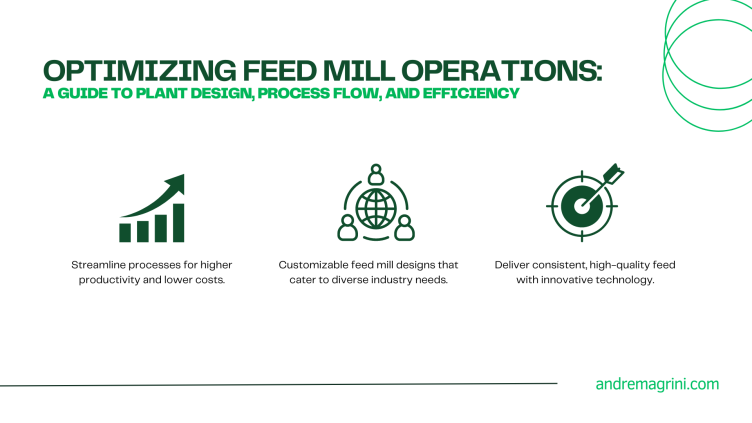
Optimizing Feed Mill Operations: A Guide to Plant Design, Process Flow, and Efficiency
Introduction: Who Are the Real Drivers of Animal Feed Production?
When we think about animal feed production, who really drives the design and operation of feed mills? The answer lies in two key customer segments: integrators and commercial operators. Each brings its own unique needs and challenges that shape how feed is manufactured, stored, and delivered.
Integrators, often large vertically integrated operations, produce feed to fuel their own farms. For them, it’s all about efficiency and scale. They require massive, consistent production runs to keep their livestock or poultry operations running smoothly without interruptions. Their focus is on high-capacity equipment, minimizing downtime, and achieving streamlined processes.
Commercial operators, by contrast, serve independent farmers with custom feed formulas, catering to different species and nutritional needs. Flexibility is their key focus, as frequent changeovers and smaller batch sizes are common. Quality and adaptability are vital, as their customers rely on them for specific, timely orders.
By understanding the distinct needs of these segments, feed mills can optimize their design and processes to serve each group effectively, creating a balance between high-volume production and the ability to meet custom demands.
Brown, Green, What's that?
In the animal feed industry, the design and operational flow of a feed mill are paramount for ensuring high-quality feed production, safety, and efficiency. A well-optimized feed mill allows for smooth material handling, accurate formulation, and stringent hygiene standards. This article dives into key aspects of feed mill plant design, the differences between brown field and green field projects, and the essential steps in the feed mill process flow. It also highlights challenges faced by commercial operators and the importance of preventing contamination in the production process.
Brown Field vs. Green Field Projects in Feed Mill Design
Before delving into the detailed plant design and operational considerations, it is crucial to understand the distinction between brown field and green field projects.
Brown field projects involve developing or upgrading an existing facility, often utilizing existing infrastructure and equipment. This approach can reduce capital expenditure and project timelines, but it comes with its challenges, including space limitations, outdated equipment, and the need to retrofit or adapt older systems (F.T. Jones, 2011). For operators looking to quickly expand capacity or improve operations with minimal disruption, brown field projects are typically preferred.
Green field projects, on the other hand, involve designing and constructing a new facility from scratch. This offers flexibility in terms of layout, equipment selection, and process optimization but requires a significant initial investment in both time and capital. Green field projects are ideal when building a facility with the latest technology and innovations, particularly in regions with ample space and lower land costs.
Both project types play an integral role in feed mill design, and the choice between them largely depends on the facility's objectives, location, and available budget.
Key Concepts in Feed Mill Plant Design
Feed mill plant design is a multifaceted process that goes beyond choosing equipment. It involves the strategic layout of machinery, ensuring efficient flow of materials, optimizing capacity, and minimizing potential contamination risks. Some key factors to consider when designing or upgrading a feed mill include:
1. Capacity Planning and Bottlenecks
The main bottleneck in most feed mills is the pellet mill, as it is typically the slowest and most complex machine in the production line. To maintain a smooth production process, upstream meal preparation areas such as batching, milling, and mixing sections should be oversized by about 20% to accommodate the bottlenecked pellet mill (F.T. Jones, 2011). This ensures that raw materials are processed in a timely manner without excessive delays or shutdowns.
2. Multi-Species vs. Single-Species Production Lines
Feed mills may be dedicated to producing feed for a single species or multiple species. A single-species production line simplifies operations and minimizes changeovers between different feed formulations. However, a multi-species production line requires greater flexibility and the ability to handle frequent changeovers, which can introduce risks of carryover and cross-contamination if not properly managed (Feed Mill Operations Lecture Notes, 2022).
In commercial feed mills, operators must accommodate custom orders from farmers, leading to frequent starts, stops, and reformulations. As a result, these mills often utilize smaller machines and focus on producing quality feed rather than maximizing capacity.
Process Flow: From Raw Materials to Finished Feed
To fully understand how feed is produced, we need to examine the key stages in a typical feed mill process flow. The following sequence provides an overview of the main steps involved:
1. Receiving Raw Materials
The process begins with the receipt of raw materials, including grains, proteins, minerals, and vitamins. Upon arrival, these materials are checked for quality and contamination. Any unsuitable materials are rejected, and acceptable materials are transferred to storage.
2. Handling: Flat Storage or Silos
After the raw materials are received, they are moved to flat storage or silos for storage. Flat storage is used for bulk materials that will be used relatively quickly, while silos provide longer-term storage with protection from environmental factors such as moisture and pests. Proper storage design ensures efficient material flow, prevents spoilage, and maintains ingredient quality (Feed Mill Operations Lecture Notes, 2022).
3. Transfer to Dosing Silos
Raw materials are then moved to dosing silos, where precise quantities of each ingredient are measured and prepared for batching. This stage is critical for maintaining the accuracy and consistency of feed formulations, ensuring that all nutrient specifications are met.
4. Batching
The batching process involves combining specific quantities of different ingredients based on the feed formulation. Automated systems are often used to ensure accuracy, speed, and consistency in batching operations. Proper batching is essential to ensuring the right balance of nutrients in the final feed product.
5. Grinding
In the grinding stage, raw materials are reduced to a finer particle size using hammer mills or roller mills. Grinding ensures that ingredients are uniformly sized, which improves the efficiency of downstream processes such as mixing, pelleting, and conditioning. Proper particle size also enhances the digestibility and nutrient absorption of the feed (Jones, 2011).
6. Mixing
After grinding, the ingredients are transferred to the mixing stage, where they are thoroughly blended to create a uniform mixture. Accurate and thorough mixing is vital to ensuring that every particle of feed contains the same nutrient profile, preventing imbalances that could affect animal health.
7. Conditioning
During conditioning, steam and other moisture are added to the feed to prepare it for pelleting. The addition of heat and moisture softens the feed particles, allowing them to bind more easily during the pelleting process. This step also helps to kill any pathogens that may be present in the feed, improving food safety (Feed Mill Operations Lecture Notes, 2022).
8. Feed Expander (Optional)
Some feed mills use a feed expander to enhance the nutritional value of the feed by applying pressure and heat. This optional step can improve the digestibility of feed and reduce the presence of anti-nutritional factors, but it requires specialized equipment and increases processing costs.
9. Pelleting
Pelleting is one of the most important stages in feed production. During this stage, the conditioned feed is forced through a pellet die, which compacts it into pellets of a specific size. Pelleting improves feed conversion efficiency, reduces wastage, and enhances the physical characteristics of the feed, making it easier for animals to consume.
10. Cooling
After pelleting, the feed must be cooled to remove excess moisture and heat. This is typically done using counter-flow coolers, which expose the pellets to cool air. Cooling is essential for maintaining the structural integrity of the pellets and preventing spoilage during storage.
11. Crumbling (Optional)
In some cases, crumbled feed is preferred, especially for young animals. Crumbling breaks down the pellets into smaller, more manageable particles without compromising the integrity of the feed. This stage is optional and depends on the target market and species being fed.
12. Screening
The feed is then passed through a screening process to remove fines (small, undesirable particles) and ensure that the feed meets the desired size specifications. Fines can be recycled back into the process to reduce waste.
13. Coating
Coating involves adding liquid fats, oils, or other additives to the surface of the pellets. This step enhances the nutritional content of the feed and improves palatability. Coating can also help to increase the shelf life of the feed by providing a barrier against oxidation.
14. Pelleting Process Control
Effective pelleting process control is critical for ensuring the consistency, quality, and efficiency of feed production. Modern feed mills utilize automated systems to monitor key parameters such as temperature, pressure, and moisture content. These systems allow operators to make real-time adjustments, ensuring that the feed meets the desired specifications.
Managing Contamination Risks
Feed contamination is a significant concern in feed mill operations. Contaminants can enter the mill through raw materials, equipment, and even personnel. To mitigate this risk, several biosecurity measures must be implemented:
External Controls: Procedures such as vehicle sanitation, entry restrictions, and pest control (e.g., controlling birds and rodents) help reduce contamination risks from outside sources (Jones, 2011).
Internal Controls: Inside the mill, maintaining hygienic conditions is essential. This can be achieved through heat treatment, disinfection, and the separation of "clean" and "dirty" zones. Proper zoning prevents cross-contamination between raw materials and finished feed.
Conclusion
Designing and operating an efficient feed mill goes far beyond just understanding the physical layout and process flow. It requires a deep understanding of the customer's end product, raw material characteristics, feed formulas, and the specific ways in which they operate. Additionally, factors such as available resources and investment goals play a significant role in shaping the design. From the reception of raw materials to the final stages of pelleting process control, every step must be carefully planned and optimized to ensure the production of high-quality feed. Whether you’re working on a brown field project or starting fresh with a green field, success relies on strategic planning, capacity optimization, operational flexibility, and stringent contamination control. Meeting these demands ensures a facility that is efficient, adaptable, and capable of meeting the evolving needs of the feed industry.
Call to Action
Ready to optimize your feed mill operations or start your next project? Whether you're looking to upgrade an existing facility or design a new one from the ground up, AGI – Ag Growth International can help you create an efficient, high-performing feed mill tailored to your needs. Let's discuss your goals, resources, and how we can make your vision a reality. Get in touch with me today!
Citations:
Jones, F.T. (2011). Biosecurity and Contamination Control in Feed Mills. Lecture presented at the Feed Mill Design Seminar.
Feed Mill Operations Lecture Notes. (2022). Plant Design Considerations. Industrial Feed Processing Symposium.
APPLY THE THINKING
Turn insight into an accountable operating decision.
Start with a focused diagnostic of the revenue, GTM, RevOps, forecast, or AI constraint.
Request an AI Revenue Diagnostic