
ORIGINAL LINKEDIN ARTICLE
How to Measure the “Hard” ROI of AI Transformation: A CRO’s Simple, Data-Driven Playbook
By André Magrini, Chief Revenue Officer, OGI Systems (An Objective Company)
In the world of Digital Transformation, we're past the conversation of if AI can drive value. The real mandate for executive leadership-and especially for a Chief Revenue Officer-is proving the "hard" Return on Investment (ROI) of AI initiatives.
Many AI projects stall or fail to secure continued funding because the benefits remain anecdotal. To move AI from a pilot program to a core component of your revenue engine, you must translate performance improvements directly into verifiable dollars.
At OGI, our approach as your "digital construction and renovation team" is always to start with a clear architectural blueprint. When implementing AI, this means focusing on precision measurement.
Based on best practices from leading technology firms, here is the simple, four-step playbook we use to measure the hard ROI of any AI deployment.
The Data-Driven Playbook for Measuring AI ROI
Measuring hard ROI is a relatively simple process-but it demands methodical discipline and a laser focus on key business metrics.
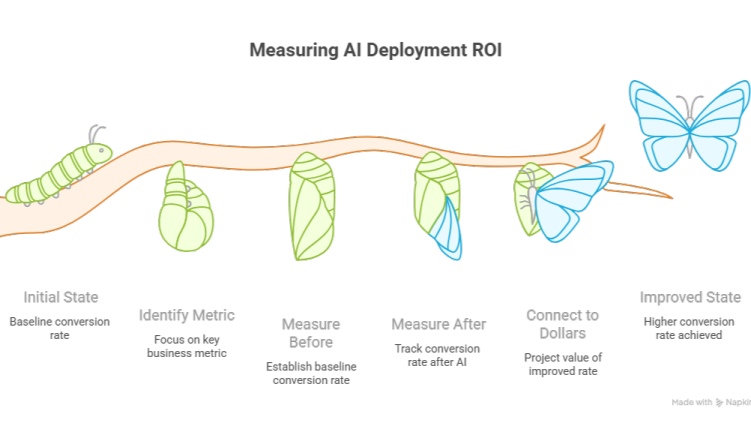
1. Pick a Specific Deployment, Not "AI" Broadly.
The scope must be narrow and actionable. Instead of trying to calculate the holistic ROI of your "AI strategy," isolate one single workflow that your team is planning to augment.
Example in Practice (The Blueprint): Your goal is not "improving sales intelligence." It is "improving the conversion rate (CVR) from BDR outreach to a booked discovery call" using a specific AI tool, such as a custom GPT to refine prospect targeting.
2. Identify the Business Metric That Matters.
The metric you choose must directly impact a measurable revenue or margin driver. If the metric is too far upstream (e.g., "AI model uptime"), its connection to the bottom line becomes speculative.
Actionable Metric (The Foundation): The critical metric here is the Conversion Rate from Outreach to Discovery Call. This single metric drives the opportunity rate and, ultimately, revenue. By impacting this metric, you are influencing a solid, revenue-driving business outcome.
3. Measure the Before and After State.
Establishing a clear baseline is the cornerstone of proving incremental value. Every "renovation" must start with a diagnosis of the "house" as it stands.
The Baseline (The "Before"): Before deploying the AI tool, determine the typical conversion rate for BDR outreach over the last quarter. This establishes your baseline performance.
The Outcome (The "After"): After a predetermined test period (e.g., three months), rigorously measure the new conversion rate achieved only by the BDRs using the AI augmentation.
4. Connect the Improvement to Dollars.
The final step is translating the percentage increase in your core metric into quantifiable financial value.
The Calculation (The ROI Link): The discovery call itself won't tell you anything about the overall outcome-you need to assign a value to it.
If your AI-driven improvement increases the number of qualified discovery calls by X and you know the conversion value of each call is Y, your hard ROI is simply X multiplied by Y, minus the cost of the AI tool.
Why This Discipline Matters
As a CRO, my focus is on predictable, scalable revenue. This methodical approach to measuring AI ROI achieves two critical goals:
De-risks AI Investment: By starting small and proving the ROI of a specific deployment, you can secure budget for larger, more strategic AI initiatives. You demonstrate financial prudence before scaling the "renovation."
Builds Internal Confidence: When your sales and finance teams see an immediate, tangible return-a clear, data-driven link between the technology and revenue-it builds unwavering confidence in the long-term digital strategy.
At OGI, we believe that AI transformation should never be a leap of faith. It should be a planned, measured process that guarantees a return. Start small, measure everything, and watch your AI investments evolve from overhead to undeniable revenue drivers.
#AI #CRO #SalesStrategy #RevenueOperations #DigitalTransformation #OGISystems
APPLY THE THINKING
Turn insight into an accountable operating decision.
Start with a focused diagnostic of the revenue, GTM, RevOps, forecast, or AI constraint.
Request an AI Revenue Diagnostic