
EXECUTIVE AI LEADERSHIP
The CEO Cannot Delegate AI: A Practical Operating System for Enterprise Value
A practical CEO operating system for turning AI adoption into enterprise value through portfolio choices, human-agent workflow redesign, proprietary intelligence, governance, and a 90-day scorecard.
AI adoption is no longer the hard part. The CEO’s real job is to convert scattered use into enterprise value by choosing the right domains, redesigning work, protecting proprietary intelligence, and setting the culture and controls required to scale.
AI is scaling faster than enterprise value
AI is already present in most large organizations. The question has shifted from whether employees will use it to whether the company can turn that use into durable financial and strategic advantage.
McKinsey’s 2026 State of AI survey reports that 89 percent of respondents say their organizations use AI regularly in at least one business function. Eighty percent report improved individual productivity. Yet only 37 percent attribute any EBIT impact to AI, and just 6 percent meet the survey’s definition of an AI high performer: at least 5 percent EBIT impact combined with significant value.[2]
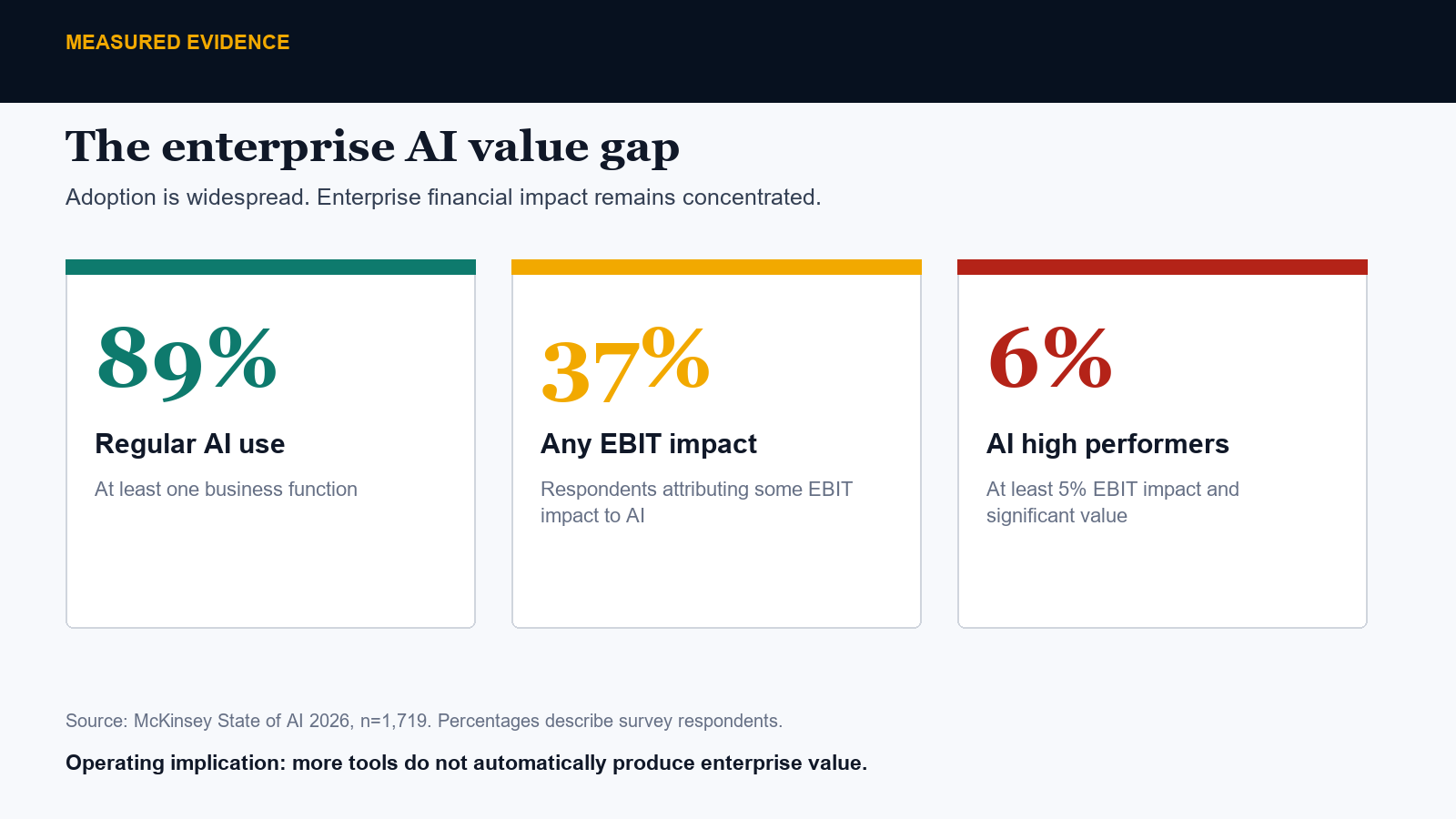
This is the value gap CEOs now have to manage. AI can improve a person’s output without changing an end-to-end workflow. It can make one team faster while creating more rework elsewhere. It can reduce the cost of a task without changing the economics of the customer journey. It can create more analysis without improving a decision.
The gap is not solved by adding more tools. It is solved by changing how the enterprise chooses, funds, governs, and learns.
The CEO’s role is not technical ownership
The CEO does not need to become the chief architect, prompt engineer, model evaluator, or data-platform owner. Those are real disciplines, and they belong with qualified technology, data, security, risk, and business leaders.
The CEO’s responsibility sits one level above the technology. It is to make the decisions that cut across strategy, capital, operating model, talent, culture, risk, and customer value. No functional executive can resolve those tradeoffs alone because each function sees only part of the system.
The source article that inspired this analysis organizes the CEO mandate around three themes: raise strategic ambition, rearchitect the organization, and reset the culture.[1] That framing is directionally right. For operating use, I translate it into five decisions that can be assigned, reviewed, and measured.
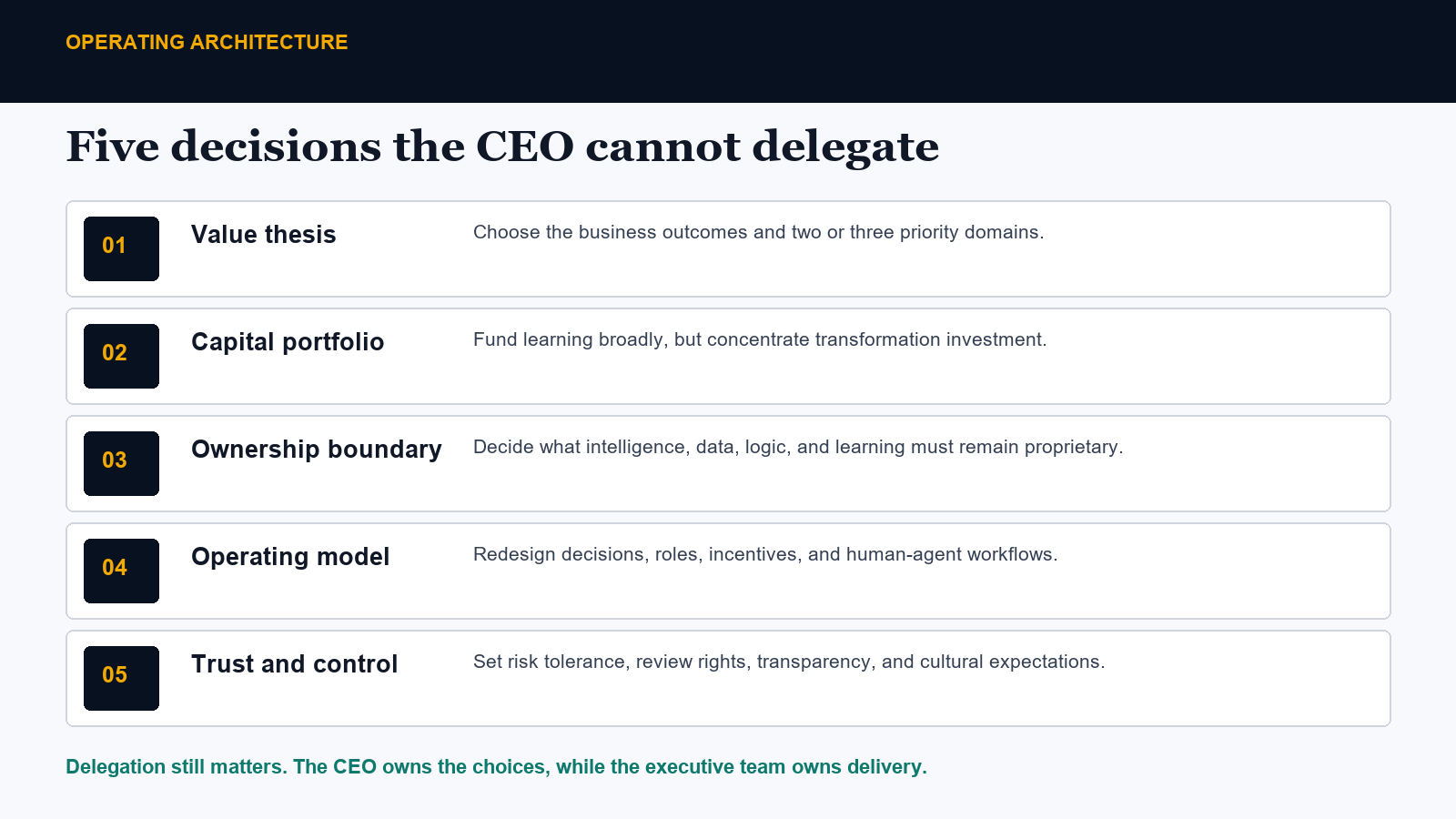
Decision 1: Define the value thesis
A serious AI strategy begins with a business thesis, not a tool inventory. The CEO should be able to explain where AI can alter the company’s growth, margin, speed, risk, or customer experience and why those changes matter now.
The most common failure is a portfolio of disconnected pilots. Each pilot may have a local sponsor and an attractive demo, but the collection has no shared theory of value. One pilot saves minutes. Another generates content. A third summarizes documents. None changes a customer outcome, a management decision, or a P&L line.
The CEO should choose two or three domains where redesign can matter at enterprise scale. A domain is larger than a use case. It might be an underwriting journey, a revenue forecasting system, a product-development loop, field-service resolution, pricing, claims, procurement, or a customer-onboarding path.
For each priority domain, leadership should write a compact value thesis:
- Business outcome: What economic or strategic result should change?
- Decision constraint: Which decision is currently slow, inconsistent, expensive, or poorly informed?
- Workflow boundary: Where does the domain begin and end?
- Human advantage: Which judgment, relationship, accountability, or creative work must remain human-led?
- Evidence threshold: What must be measured before additional capital is released?
This is the point where an AI strategy consultant should help leadership make choices, not expand the list of possibilities.
Decision 2: Run AI as a capital portfolio
AI spending often becomes fragmented across software budgets, cloud consumption, data work, consulting, experiments, and employee subscriptions. That fragmentation makes it difficult to see the full investment or compare projects on a common basis.
The CEO and CFO should treat enterprise AI as a portfolio with different capital logics:
| Portfolio lane | Purpose | Funding logic | Scale evidence |
|---|---|---|---|
| Fluency | Build broad employee capability | Managed learning budget | Adoption, safe usage, demonstrated task improvement |
| Workflow improvement | Remove friction from existing work | Business-case funding | Cycle time, quality, cost, exception rate |
| Domain redesign | Change an end-to-end value stream | Concentrated transformation capital | Customer, revenue, margin, risk, or strategic impact |
| Strategic option | Test a new product or business model | Stage-gated venture capital | Demand evidence, unit economics, defensibility |
Broad access can build literacy, but transformation capital should remain concentrated. The board should see which investments are designed for learning, which are designed for efficiency, and which are expected to create growth. Blending those categories invites inflated ROI claims.
Token cost matters, but token cost is not the business case. The relevant unit is the cost of an acceptable outcome, including model usage, data retrieval, orchestration, review, rework, integration, monitoring, and the human time required to handle exceptions.
Decision 3: Protect proprietary intelligence
Models will change. Vendors will change. Prices and performance will change. The CEO should assume that the underlying model layer will become increasingly substitutable and ask what the company must own when that happens.
Proprietary advantage usually sits in five places:
- Data rights: lawful access to relevant, high-quality operational and customer data.
- Decision logic: the rules, constraints, economics, and judgment patterns that shape good decisions.
- Semantic context: the definitions and relationships that allow systems to interpret company information correctly.
- Feedback loops: the corrections, outcomes, and exceptions that improve performance over time.
- Operating integration: the ability to embed intelligence into real workflows rather than isolate it in a chat window.
The CEO should not design the architecture, but the CEO must set the ownership boundary. Which data can leave the company? Which decisions may be made by a third-party service? What logs must be retained? What knowledge should be portable across models? What happens if a provider changes terms, pricing, geography, or competitive posture?
NIST’s AI Risk Management Framework and its Generative AI Profile provide a useful governance foundation. They emphasize risk identification, measurement, management, and governance across the AI lifecycle, including third-party dependencies, human oversight, documentation, and data provenance.[4]
An AI governance advisor can help translate those principles into decision rights and evidence without turning governance into a separate bureaucracy.
Decision 4: Redesign work around human-agent teams
Adding AI to a broken workflow usually makes the broken workflow faster. Enterprise value appears when leadership redesigns the sequence of decisions, handoffs, controls, and responsibilities around the capability.
The core design unit should be the decision, not the tool. Start by asking what decision the workflow exists to support. Then identify what the agent can retrieve, analyze, generate, recommend, or execute, where human judgment is essential, and which control must observe both.
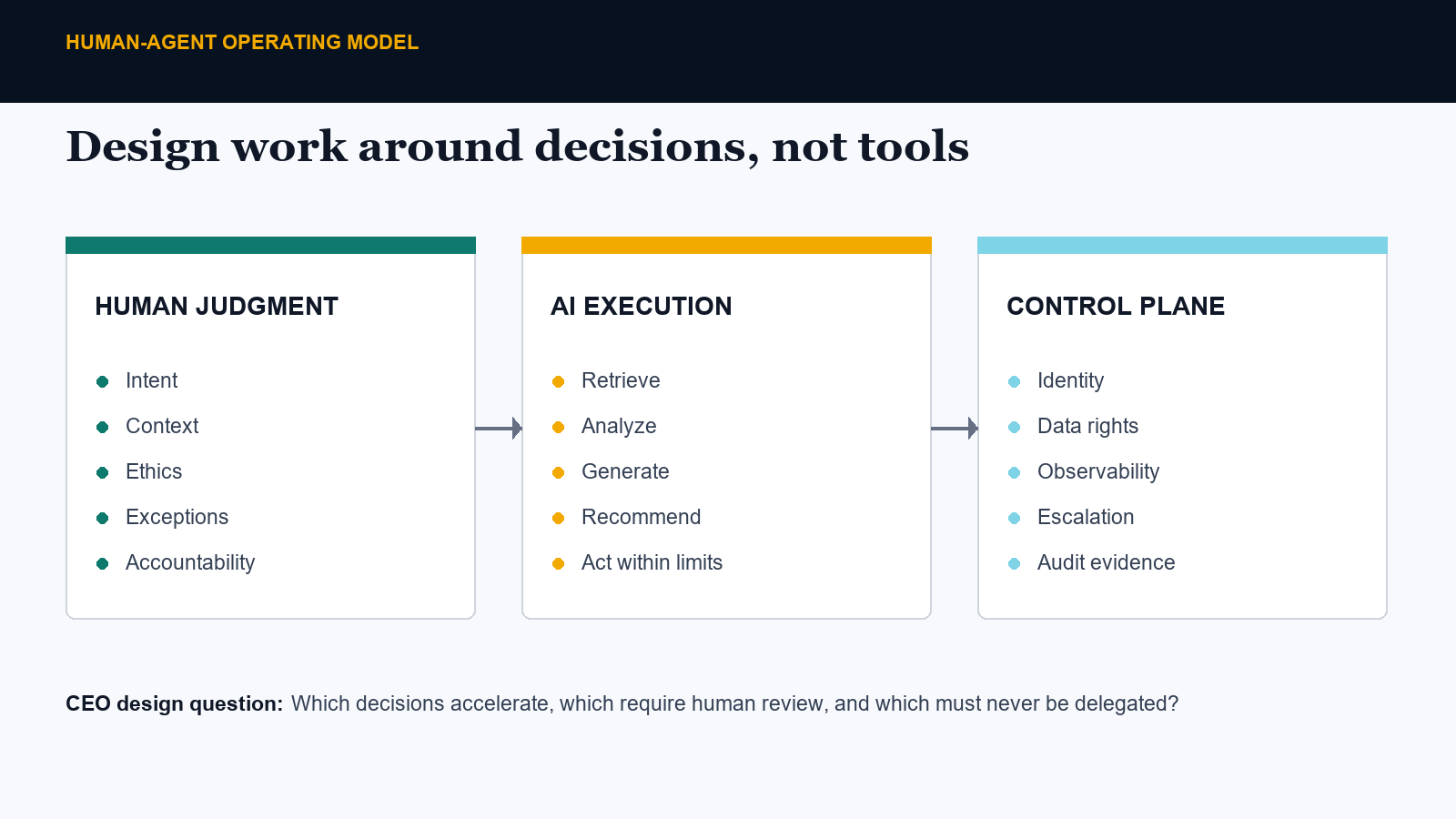
That design changes management. Meetings can become exception-driven instead of calendar-driven. Planning can become more continuous. Managers can spend less time gathering information and more time exercising judgment, coaching people, and resolving tradeoffs.
It also changes role definitions. A job description that lists tasks is less useful when tasks can move between humans and agents. Leadership must define outcomes, judgment boundaries, escalation rights, and accountability for the combined system.
The CIO owns the enabling architecture. The CFO owns investment discipline. The CHRO owns workforce transition and capability development. The COO owns operational sequencing. Business leaders own outcomes. The CEO ensures those accountabilities form one enterprise system rather than five functional programs.
Decision 5: Build trust and control together
AI adoption is a human transformation. Employees watch what leaders measure, reward, protect, and use themselves. If senior leaders speak about AI as a priority but do not change their own behavior, the organization learns that the message is temporary.
Trust does not mean removing control. It means making the control model understandable:
- People know when they are interacting with or relying on AI.
- Teams know which uses are allowed, restricted, or prohibited.
- Owners know when human review is mandatory.
- Employees can report failures without being punished for surfacing evidence.
- Customers and regulators receive appropriate transparency.
- Leaders can inspect performance, cost, risk, and exceptions.
McKinsey’s organizational research distinguishes enablement, automation, and reinvention. Its findings emphasize that technology deployment alone does not create enterprise value and that leadership behavior, workflow change, skills, and culture become more important as organizations move toward reinvention.[3]
The CEO should therefore model learning without pretending certainty. That includes using AI personally, asking better questions, admitting where pilots failed, and making it safe for executives to surface resistance, risk, and weak evidence.
A board-ready CEO scorecard
A useful AI scorecard should separate activity from value. Usage is an input, not an outcome. The board needs a compact view of whether the enterprise is learning, whether the workflow is improving, whether value is appearing, and whether risk remains inside tolerance.
| Dimension | Questions | Example evidence |
|---|---|---|
| Strategic value | Is AI changing a priority business outcome? | Revenue, margin, retention, risk, capacity, customer outcome |
| Workflow performance | Did the end-to-end system improve? | Cycle time, quality, rework, exception rate, handoff delay |
| Adoption quality | Are the right people using the system correctly? | Active use, completion, override patterns, abandonment |
| Economics | What does an acceptable outcome cost? | Model, infrastructure, review, integration, support, rework |
| Risk and trust | Is performance inside the approved tolerance? | Incidents, drift, access violations, complaints, audit findings |
| Learning velocity | Is the system improving from real outcomes? | Time to correction, feedback coverage, reusable knowledge |
The scorecard should show the denominator behind every rate, the baseline, the review period, and the owner. A green dashboard with no decision attached is decoration.
A 90-day CEO agenda
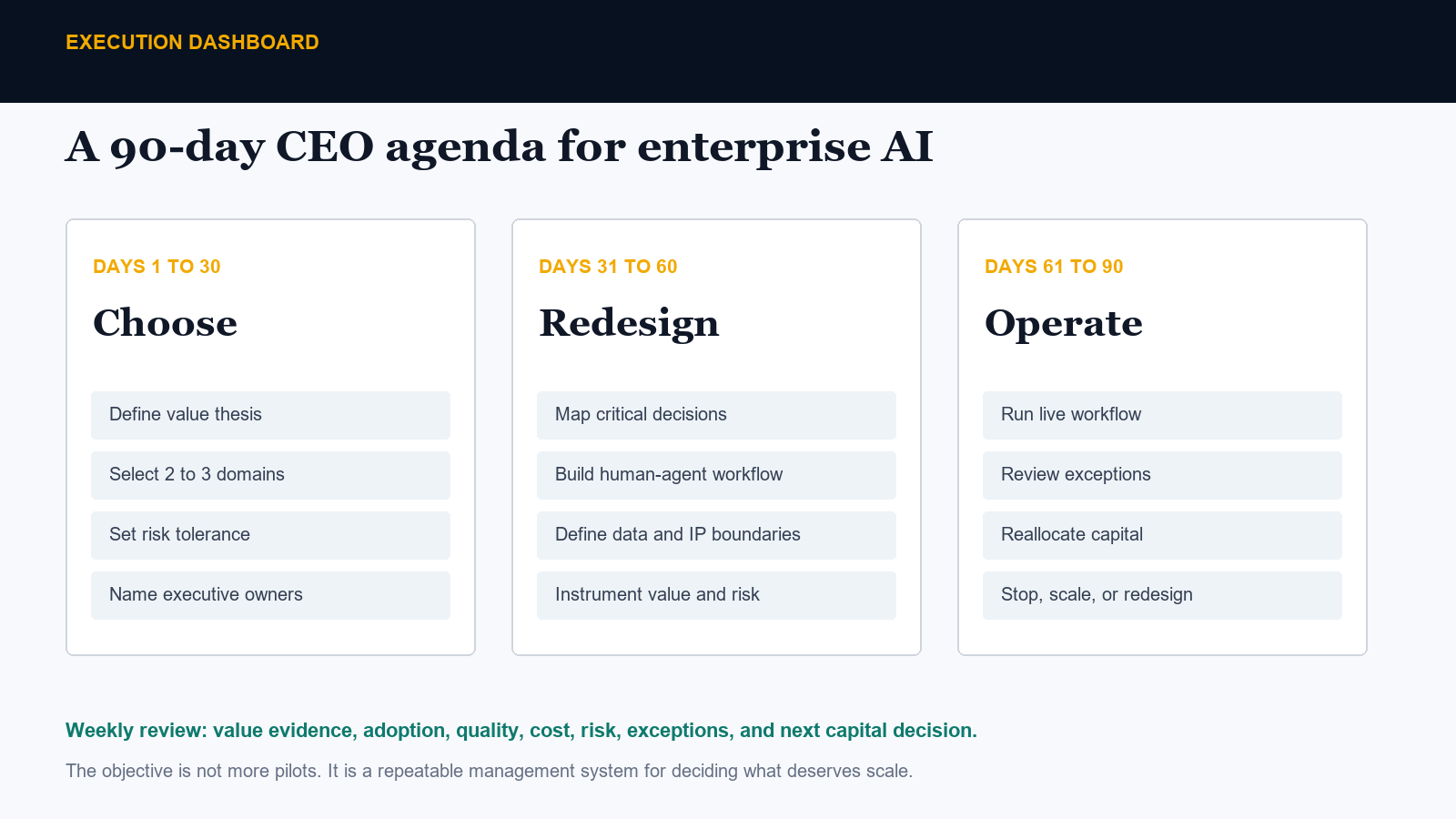
The first 90 days should not attempt to transform the entire company. They should install a repeatable management system for deciding what deserves scale.
Days 1 to 30: Choose
Define the value thesis, choose two or three priority domains, set risk tolerance, establish capital lanes, and name accountable executive owners. Inventory existing pilots, vendors, data dependencies, and hidden operating costs. Stop projects that cannot identify a business owner or decision.
Days 31 to 60: Redesign
Map the critical decisions and handoffs inside the first priority domain. Design the human-agent workflow, define data and intellectual-property boundaries, establish review and escalation rules, and instrument value, quality, cost, adoption, and risk.
Days 61 to 90: Operate
Run the workflow with real users and real work. Review exceptions weekly. Compare outcome cost with the baseline. Capture corrections and failure modes. At the end of the period, make an explicit capital decision: stop, narrow, redesign, or scale.
Questions every CEO should ask
- Which two or three domains could materially change our growth, margin, risk, or customer experience?
- What evidence shows that AI improves the whole workflow rather than one task?
- Which intelligence, data, decision logic, and learning loops must remain ours?
- What is the full cost of an acceptable outcome, including human review and rework?
- Where is human judgment mandatory, and who remains accountable?
- What failure would exceed our risk tolerance?
- Which current pilots should be stopped because they lack ownership or value evidence?
- How will productivity gains be converted into enterprise capacity or growth?
- What behavior must the executive team model for the culture to change?
- What decision will the board make from the next AI report?
What the CEO should not do
The CEO should not centralize every AI decision, choose models based on demos, announce savings before workflows change, or treat employee adoption as proof of enterprise value. The CEO should not use new transparency to create a micromanagement system. And the CEO should not let governance become an excuse to avoid making strategic choices.
The objective is disciplined decentralization. The CEO sets the value thesis, decision rights, capital rules, ownership boundaries, risk tolerance, and cultural expectations. Teams then operate inside that system with enough autonomy to learn quickly.
The leadership conclusion
AI is not another software rollout. It changes the economics of decisions and the architecture of work. That is why the CEO matters so much.
The CEO’s singular contribution is not technical expertise. It is enterprise coherence: aligning strategy, capital, technology, people, operations, governance, and customer value around a small number of consequential choices.
Companies that do this well will not necessarily use the most models or launch the most pilots. They will learn faster, allocate capital more intelligently, protect what makes them distinctive, and redesign work before competitors can convert the same widely available technology into a better operating system.
For organizations that need senior ownership before hiring a permanent executive, a Fractional Chief AI Officer can help install the portfolio, governance, scorecard, and operating cadence. The role is not a substitute for CEO ownership. It is a mechanism for turning CEO decisions into an accountable system.
Convert individual productivity into enterprise capacity
One of the most important CEO distinctions is the difference between an employee becoming faster and the enterprise gaining usable capacity. If a salesperson drafts an email in half the time but still waits three days for pricing approval, the revenue cycle has not improved. If an analyst produces a report faster but the management meeting still debates definitions, decision latency remains. If customer service resolves simple cases faster but difficult cases bounce between teams, the operating constraint has only moved.
Leadership should trace productivity gains to their next destination. Capacity can be reinvested in growth, better service, innovation, control, or a lower cost base. If the destination is not explicit, time savings are absorbed by more activity and disappear from the P&L.
A useful capacity review asks four questions:
- Which work actually disappeared, and which work merely moved to another person or system?
- Did throughput, quality, customer outcome, or decision speed improve at the workflow level?
- What will the organization do with the released time, budget, or management attention?
- Which metric will prove that the reinvestment produced enterprise value?
This is where CEO ownership becomes tangible. The value of AI is not the number of hours a tool claims to save. It is the quality of the capital and operating decisions that convert those hours into a stronger company.
Sources and editorial context
- McKinsey & Company, The CEO’s singular impact on the success or failure of AI in organizations, September 2026. This article is an independent operating interpretation and adaptation, not a reproduction.
- McKinsey & Company, The state of AI in 2026: On the road to ROI, August 25, 2026. Survey fielded May 4 to June 8, 2026, with 1,719 participants across 97 nations.
- McKinsey & Company, From adoption to impact: Three horizons of AI transformation, July 8, 2026.
- National Institute of Standards and Technology, AI Risk Management Framework, including the Generative AI Profile.
Author note
Andre Magrini is a global chief revenue officer, fractional CRO, and AI revenue architect based in the Greater Chicago Area. His work connects AI strategy, revenue architecture, governance, GTM execution, and operating evidence.
APPLY THE THINKING
Turn this analysis into an accountable operating decision.
Start with the revenue, GTM, RevOps, governance, or AI constraint that matters most.
Request an AI Revenue Diagnostic